 EN
A mens workwear jacket gets specified wrong more often than any other uniform piece. Buyers pick a colour, ask for a price, and skip the two questions that decide whether the crew wears it: how the pattern fits a man who reaches overhead all day, and what the pockets have to carry. Here's how we'd spec a mens workwear jacket before a first bulk order. No catalogue adjectives. Just the pattern, the load, and the tests we'd ask for.
Start With the Pattern, Not the Photo
A mens workwear jacket is cut on a male block, and that changes everything downstream. Shoulder slope, chest-to-waist drop, sleeve pitch and back length all differ from a unisex or women's graded pattern. A unisex shell pulled across a male frame rides up at the back when the wearer reaches forward, because the armhole was drafted for a straighter torso.
Ask your supplier which block the mens workwear jacket is built on, and to see the pattern rather than just the sample. If they can't show a separate male grade rule, the jacket is a unisex style wearing a new label. That's fine for a role with little overhead work. It's a problem for anyone on a ladder.
Fit It to the Movement, Not the Size Chart
Men don't stand still on the job. They bend into a van, reach across a pallet, and lift with their arms above their head. The work jacket fit has to hold at the wrist and still cover the lower back when the wearer leans. Test the pattern on a person, not on a table: reach up, twist, squat, and look at where the fabric pulls.
Sleeve pitch is the detail most buyers miss. A sleeve drafted for a hanging arm fights a man who works with his hands forward, and the underarm seam rides into the armpit within an hour. Ask whether the sleeve on your mens workwear jacket is set for a forward-reaching posture. It's a pattern decision, not a fabric one.
Build a Size Curve That Fits the Crew
A single sample size proves nothing about a mens workwear jacket. Crews run from a slim 38 chest to a 52, and a work jacket size curve has to cover that span without special orders. Start with the sizes your headcount actually wears, then check the grade between them. A jump of 4 cm at chest with no change in sleeve length gives you a jacket that fits the middle and fails at both ends.
Ask for a full size-set sample before you commit. Measure chest, sleeve and back length across the set, not just the one size on the mannequin. Shrinkage after industrial laundry moves those numbers again, so request the washed measurements alongside the dry ones. A mens workwear jacket that fits on day one and shrinks two sizes by week six is still a failed spec.
Pockets Are a Load-Bearing Decision
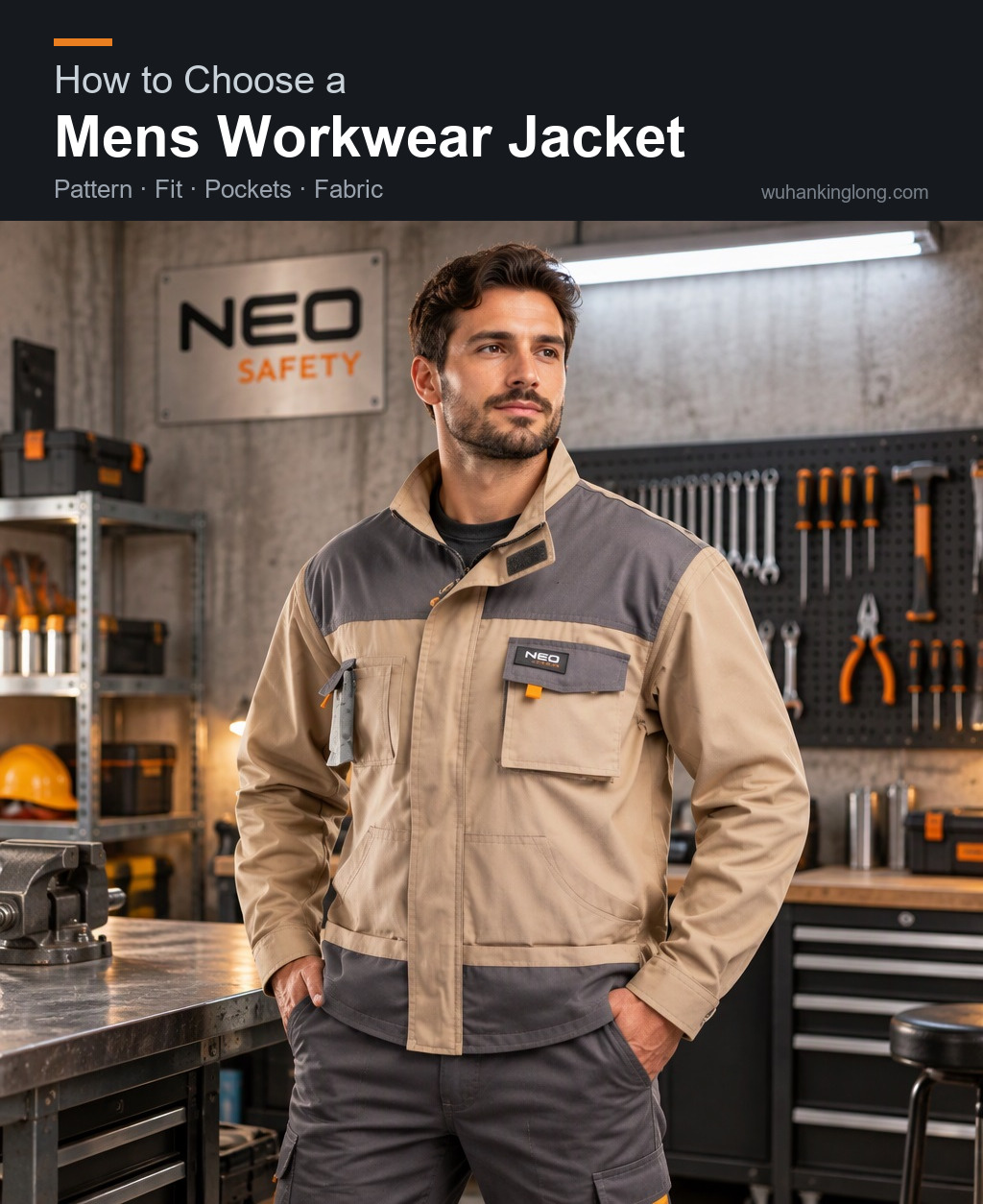
The work jacket fit on a tradesman is judged by its pockets as much as its shoulders. A tape measure, a phone, a marker and a set of keys add up to real weight, and a mens workwear jacket carries that weight on the pocket bag and the seam that holds it. Two flapped chest pockets and two deeper hand pockets cover most roles. Go beyond that and you're adding cost and snag points nobody asked for.
Name the pocket bag fabric in the spec. Poly-cotton holds a corner; mesh tears within a season of carrying tools. Ask for reinforced seams with bar-tacks at each pocket mouth, four stitches rather than two, and check pocket depth against what the crew actually carries. A phone that slides out of a shallow work jacket pocket on a bend is a daily annoyance a spec sheet can prevent.
Match the Fabric to the Job, Not the Season
A canvas work jacket at 320 to 380 g/m² takes abrasion from concrete and steel better than a poly-cotton twill, but it holds water and takes twice as long to dry overnight. A 65/35 poly-cotton shell at 240 to 280 g/m² dries fast and holds colour through industrial washing, and it's the default for general site work. Neither is right for every crew. Pick the fabric against the risk on the job, not the look in the catalogue.
If the role is active and the weather is mixed, a bonded softshell moves better, though the face scuffs at the cuff first. Our softshell jackets cover that build. Whatever you choose, ask for a Martindale abrasion result to EN ISO 12947-2 on the mens workwear jacket shell if it will be worn against rough surfaces. A weight on its own tells you how much fibre is in the cloth, not how long it lasts.
What We Check Before a Mens Workwear Jacket Goes Bulk
Every mens workwear jacket in a bulk run starts with a sealed sample, and we check the shipment against it. That means the fabric lot, the pocket bar-tacks, the zip and the grade measurements all match what was approved. It sounds basic. Most complaints we hear come from a bulk order that drifted from the sample in one of those four places.
We've made workwear and uniforms in Hubei for over 20 years, run three million pieces a year under ISO 9001, and hold OEKO-TEX Standard 100 on materials; SGS and ICS audits come from European partners. The certificate and test report list shows the documents. For protective claims, the mens workwear jacket has to meet the relevant standard in the destination market, and Regulation (EU) 2016/425 sets the conformity route for PPE sold in the EU. Ask which claim, if any, is printed on your label.
Questions Buyers Ask
How should a mens workwear jacket fit? Close at the shoulder, with enough room across the chest to reach forward without the hem lifting. It should cover the lower back when the wearer bends. If a man has to pull the sleeve down to reach a shelf, the pattern is wrong.
What fabric is best for a mens workwear jacket? For general site work, a 65/35 poly-cotton twill around 260 g/m². For heavy abrasion, canvas at 320 g/m² and up. For active work in mixed weather, a bonded softshell. Match the fabric to the risk, and ask for the test result behind the claim.
Can I add our logo and change the colours? Yes. Colour, logo method and the pocket map are set at the pre-production sample. MOQ depends on whether you take a stock colour or a custom dye lot.
What's the difference between a work jacket and a uniform jacket? A work jacket is specced for movement and load; a uniform jacket for appearance. A mens workwear jacket sits closer to the work end, because the crew wears it to do a job, not to stand at reception.