 EN
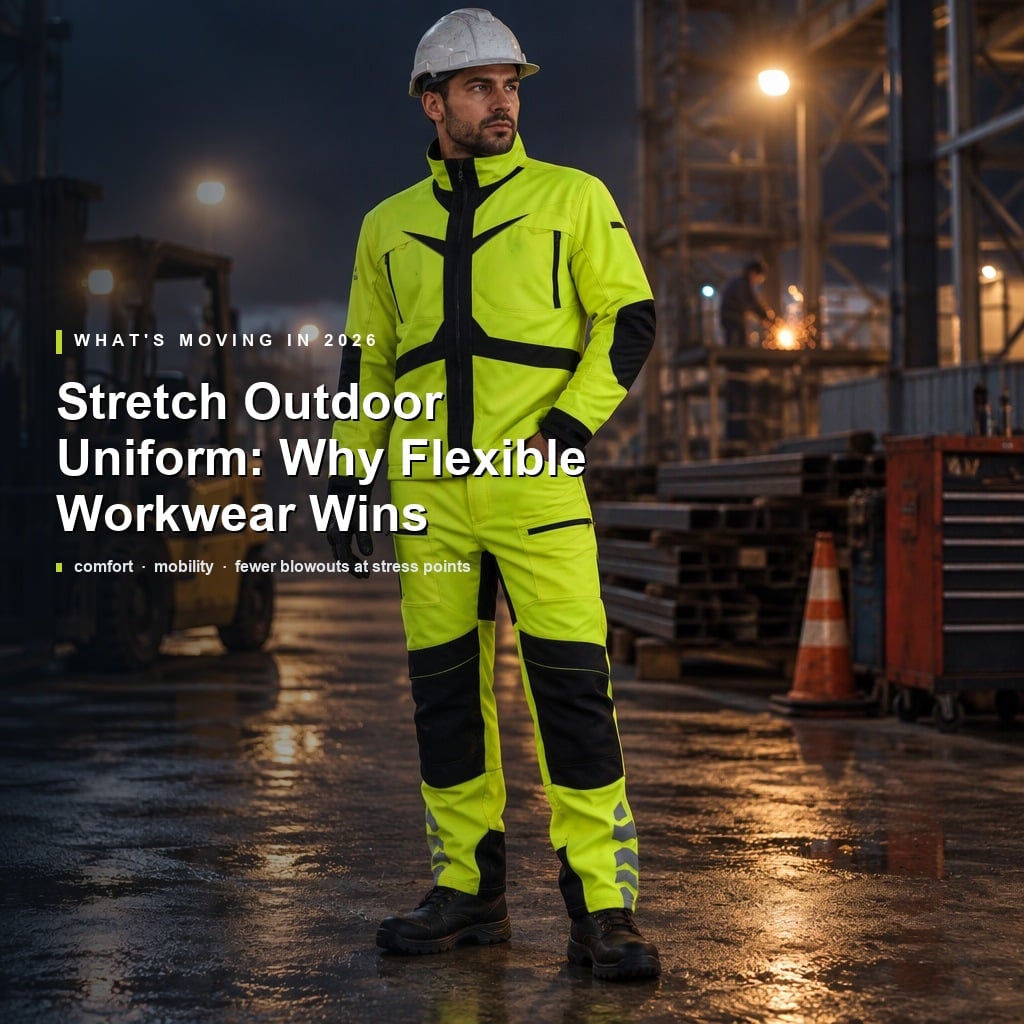
Rigid workwear has one failure mode that never shows up in a spec sheet: it fits you standing still. The moment a crew member steps over a barrier, kneels at a valve or reaches above a shoulder, the fabric either gives or the seam does the giving for it.
That is the argument for a stretch outdoor uniform, and it is not a comfort claim. Range of movement is measurable — seam elongation, recovery, the load a stitch line carries at full extension — and it changes what a garment costs over three seasons.
Why Stretch Became the Default in Outdoor Uniforms
Three things pushed it from a niche riding fabric into mainstream site wear.
The work changed. Utilities, grounds maintenance, rail depots and ground handling all involve climbing in and out of vehicles, kneeling and reaching across a body. A rigid twill fights those movements at the hip and knee, so crews take the outer layer off — the failure that costs you the audit.
Thin beat thick. A modern stretch outdoor uniform fabric hits usable abrasion figures at 220–260 gsm for trousers, where a decade ago you needed 300 gsm-plus canvas for the same life.
It solved a stock problem. A well-graded stretch shell covers a wider body range per size, so a distributor carries fewer SKUs. That matters more than comfort when you commit to stock.
Fabric Choice: Polyester/Spandex vs Nylon/Spandex
Stretch arrives one of two ways. Either the yarn is elastic — elastane, called spandex in North America, blended at 8–15% — or the knit supplies mechanical stretch with no elastic yarn. Elastic yarn recovers better and tolerates a wider fit; mechanical stretch holds its dimensions at high temperature and does not degrade with chlorine.
The practical split for a mixed-climate programme is blended: a polyester spandex fabric where shape retention and fast drying matter, nylon/spandex where the fabric meets abrasion. A polyester spandex fabric also holds fluorescent shades better, which matters the day someone asks for lime.
Property |
Polyester/Spandex |
Nylon/Spandex |
Abrasion resistance |
Good |
Better — the default for trousers and knee panels |
Hand feel |
Drier, slightly crisper |
Softer, cooler on skin |
Drying speed |
Faster |
Slightly slower |
Colour retention |
Excellent, including fluorescent shades |
Good; needs tight dye-lot control in pale greys |
Cost |
Lower |
Higher |
Sensible use |
Stretch work jacket shell, sleeve panels |
Stretch work pants, knee reinforcement, seat |
Going all-nylon raises unit cost for a benefit the jacket does not need. Going all-polyester shortens trouser life exactly where it wears — knee, seat, hem. Splitting the two inside one stretch outdoor uniform is the cheap engineering decision, not a compromise.
The Sewing Room and the Size Range
Most stretch outdoor uniform complaints trace to the stitch line, not the fabric.
Tension, not stitch type, is the usual culprit. Woven stretch runs on a flat-bed machine at roughly 3 to 3.5 stitches per centimetre, with low thread tension and overlock at the raw edges. Knitted stretch goes through a four-thread flatlock. Set the tension for a rigid fabric and the seam ripples on the first wash — puckering is the top return reason in this category, and it is a machine setting.
Tape is a separate component. Retroreflective tape on a four-way stretch garment has to be a stretch grade. Standard tape cracks at the flex points and loses retroreflective values long before the garment looks worn.
Heat transfer is where logos fail. Standard high-temperature film kills local elasticity; two washes later the print edge lifts. Specify low-temperature elastic film and log the pressing temperature on the tech pack.
A four-way stretch outdoor uniform lets one grade cover more bodies, but it does not remove the need for a grade. Sleeve and leg length still run in steps, and a jacket and trouser built on the same grading let a buyer order one ratio for the set — the actual commercial win, not the elastane percentage.
Breathability, DWR and the Trade-off Nobody Mentions
Breathability in a knit comes from structure: air moves through the fabric, so moisture leaves without a membrane. That is why a knit stretch outdoor uniform outperforms a coated shell in heat and underperforms it in sustained rain.
The trade-off in a stretch outdoor uniform sits in the finish. A durable water repellent keeps rain off the surface, and softeners, some elastane lubricants and the wrong wash chemistry all strip it. Two rules follow: test DWR after laundering, not on the sample, and never quote a waterproof rating from a DWR finish alone. Water-repellent and waterproof to EN 343 are different claims, and a buyer who learns the difference in the first storm does not reorder.
Hi-Vis Colour Is Not a Certificate
Fluorescent lime is a colour. It is not a class, and it is not a compliance story.
EN ISO 20471 assigns classes by measured areas of fluorescent background, retroreflective material and contrast material on the finished garment, plus chromaticity limits per dye lot. A stretch outdoor uniform complicates three of those: fabric relaxes and recovers, so areas are measured as worn; the tape must be a stretch grade; and elongation has to be verified rather than assumed. Under Regulation (EU) 2016/425, a hi-vis claim also needs a declaration of conformity naming the notified body.
Treat certification as a project with cost and lead time. A supplier who answers "yes, hi-vis" in one line has either tested it or is guessing. Ask which.
Care Rules That Keep Elastane Alive
Elastane dies from heat and chemistry, not wear. 40°C maximum, no fabric softener — it coats the fibre and kills wicking and DWR both. No chlorine bleach. No high-temperature tumble drying: heat is what destroys recovery. Re-proof the DWR after roughly 20–25 industrial washes.
A stretch outdoor uniform that bags at the knee after a season was usually washed hot and dried hot. It is a laundry instruction problem, and it belongs in the contract, not a conversation after the first complaint.
Sourcing Notes
Ask any outdoor uniform supplier three questions before comparing price: elastane percentage and stretch direction, wash-test data at your customers' laundry regime, and whether tape and transfer film are stretch grades. Those answers separate a factory from a trader with a catalogue.
Wuhan Kinglong Protective Products has made workwear for over twenty years, runs three million pieces a year under ISO 9001 and holds OEKO-TEX Standard 100 on its material supply. Stretch programmes are cut and sewn in-house, so the tension settings that decide seam behaviour stay under our control. The stretch outdoor uniform range covers the WH731 stretch work jacket and WH732 stretch work pants; the hi-vis range is where certified visibility programmes sit, plain work trousers cover the rigid end, and our certifications are listed with scope rather than logos alone.
Send a crew size ratio and site conditions; you get fabric options, a grade set and a price. Every supplier says that. We do it in two working days.
Frequently Asked Questions
What is a stretch outdoor uniform usually made from?
A polyester/spandex or nylon/spandex knit with 8–15% elastane, or a mechanical-stretch woven with no elastic yarn. Each panel in a stretch outdoor uniform is chosen for where it meets wear — nylon/spandex at the knee, polyester/spandex on the shell.
Does stretch fabric wear out faster than rigid workwear?
Not at equal weight, but a stretch outdoor uniform fails differently. Stretch abrades at the knee and seat rather than the seam, which is why reinforced panels matter more here than in a canvas trouser. Below about 220 gsm, expect a shorter service life.
Can a stretch outdoor uniform be EN ISO 20471 certified?
Yes, after testing — not by declaration. The finished garment needs the fluorescent and retroreflective areas, a chromaticity test per dye lot, stretch-grade tape with verified elongation and a declaration of conformity. Budget it separately.
How many washes before the stretch goes?
A four-way stretch knit holds its recovery well past 50 domestic washes at 40°C. What fails first is the DWR, around 20–25 industrial cycles, and the tape if it is not a stretch grade. Wash temperature is the biggest single variable.
What MOQ applies to a custom stretch outdoor uniform?
Every outdoor uniform supplier quotes differently: stock colours start lower than custom dye lots, and lead time runs from sample approval. Send a size ratio and a target quantity for a firm number rather than a range.
Table of Contents
- Why Stretch Became the Default in Outdoor Uniforms
- Fabric Choice: Polyester/Spandex vs Nylon/Spandex
- The Sewing Room and the Size Range
- Breathability, DWR and the Trade-off Nobody Mentions
- Hi-Vis Colour Is Not a Certificate
- Care Rules That Keep Elastane Alive
- Sourcing Notes
- Frequently Asked Questions