 EN
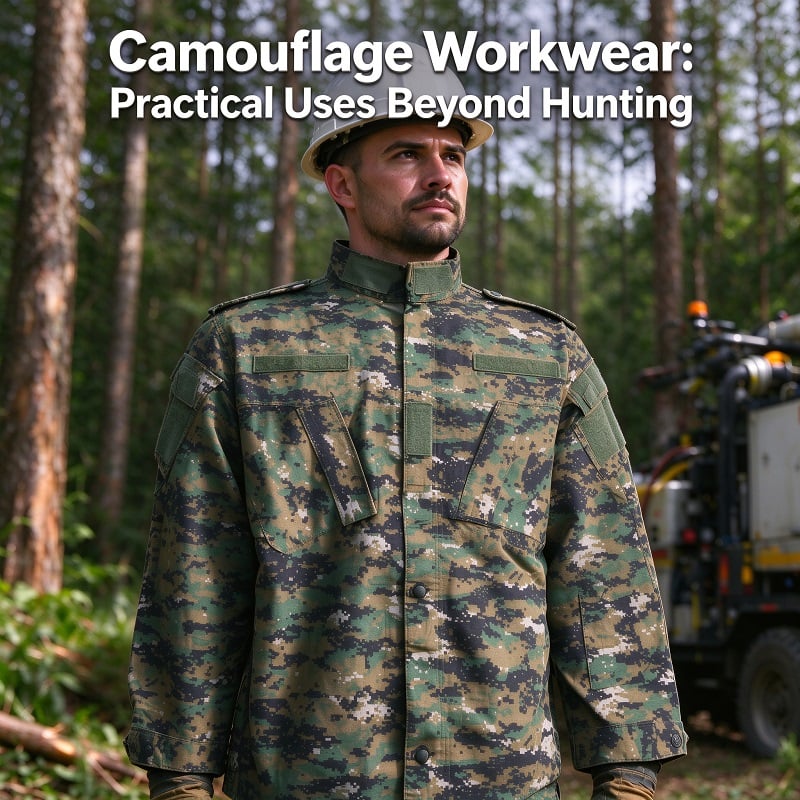
Camouflage workwear earns its place on job sites for three practical reasons that have nothing to do with hunting: it hides dirt and staining between washes, it reduces visual glare in outdoor and remote work, and it fits uniform codes for trades where neutral disruptive patterns are accepted. For a crew that works outdoors for full shifts, a camo pattern can cut replacement frequency and keep a uniform looking presentable longer.
This guide is for distributors, brand owners and safety procurement teams sourcing camouflage workwear for landscaping, utilities, forestry, construction and outdoor service programs in North America and Europe.
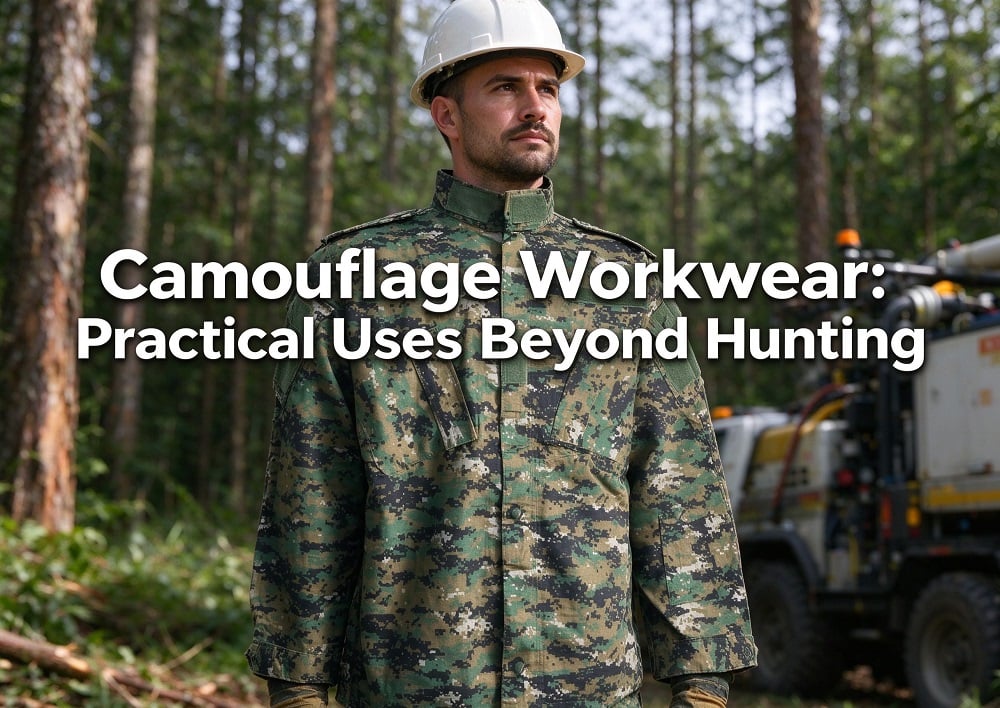
Why a crew would wear camo on the job
Hunting is the well-known use, but the buying reasons for camouflage workwear on a job site are different:
- Stain camouflage. Landscape crews, arborists and utility workers deal with soil, sap, grease and mud. A disruptive pattern hides the staining that makes a solid-color uniform look worn out after a week. The garment lasts visually longer, which means fewer complaints and later replacement.
- Reduced glare. Outdoors, a bright solid color can throw glare and stand out against terrain, which matters for crews working near game management, conservation, or sites where blending with the environment reduces disturbance to wildlife and the public.
- Uniform identity. Some trades — land management, range crews, conservation and certain utility contractors — adopt camo as a recognized work uniform. It reads as outdoor-pro, not as a fashion choice.
- Durability expectations. Camo workwear is usually cut in the same rugged fabrics as hunting wear, so buyers get heavy-duty construction as a side benefit. For a field crew that does not want to reorder mid-season, that durability is what makes camouflage workwear a lower-cost option over the full season.
When camo workwear is the wrong call
Camo is a specialized choice, and it fails in specific settings. Before you build a program around camouflage workwear, check whether it conflicts with the site's safety or brand rules:
- Hi-vis required sites. If the site rule demands hi-vis (road work, plant floors, rail), camo does not meet the reflective or color requirement on its own. Camo is often combined with a hi-vis vest or hi-vis trim instead, which is a common compromise on mixed-use sites.
- Corporate or customer-facing uniforms. If the crew is the face of the brand in front of clients, a camo uniform may not fit the image. Many buyers keep camo for field crews and solids for front-office and client-facing staff.
- Indoor or light-abuse work. In a clean indoor setting, camo adds nothing and can look unprofessional. Solid or branded workwear is the default there.
The rule of thumb: use camouflage workwear where it solves a real problem — staining, glare, or a recognized field uniform code — and reach for solid or hi-vis workwear everywhere else. That is the test that keeps camouflage workwear a practical choice on site instead of a stylistic one.
Fabric choices for camo workwear
Camouflage workwear uses the same fabric families as outdoor workwear, and the pattern does not change the performance:
Fabric |
Use |
Tradeoff |
Poly-cotton ripstop |
General outdoor work, utilities |
Tear-resistant, breathable |
Cotton canvas |
Heavy field work, forestry |
Rugged, stiff until broken in |
Poly-cotton twill |
Uniform programs, range crews |
Wrinkle-resistant, easy to launder |
Stretch blend |
Arborists, climbers, installation |
Flexible, less abrasion resistance |
Softshell (outer layer) |
Cool and wet weather |
Wind and water resistance |
The pattern is printed or woven into the fabric. Printed camo is cheaper and more common; woven camo lasts longer but costs more and has fewer colorways. For work programs that get washed hard, confirm the pattern does not fade or crack after repeated laundering — this is the most common return reason on camouflage workwear, and it is cheaper to verify on a swatch than on a bulk order.
How to spec camo workwear for a program
Spec'ing camouflage workwear for work is the same job as spec'ing solid workwear, plus one extra decision about the pattern. Work through these points:
- Pick the pattern for the environment. Woodland, desert and urban patterns each suit a terrain. Buy the pattern that matches where the crew works, not just what looks good on a screen.
- Confirm the fabric weight. Match it to the trade, exactly as you would for solid workwear — lightweight for warm-season crews, heavier for forestry and cold-weather outdoor work.
- Check the reinforcement points. Pocket corners, seat, knees and sleeve elbows on camo workwear should be reinforced the same way as solid workwear.
- Decide on hi-vis integration. If the site needs visibility, spec camo with hi-vis trim or plan a separate hi-vis vest over it.
- Verify wash performance. The pattern must survive the industrial or frequent wash cycle your program uses. Ask for a wash test on the actual print, and confirm the print stays within tolerance across reorders — a camouflage workwear program only works if the second batch matches the first.
Sourcing checklist
- Site rule confirmed: is camo allowed, and is hi-vis required on top?
- Pattern matched to the actual terrain the crew works in
- Fabric weight matched to the trade and season
- Print vs woven camo decided; wash test passed on the pattern
- Seat, knees, elbows and pocket corners reinforced
- Hi-vis integration settled (trim or separate vest)
- Size run covers the real staff distribution
- Colors consistent across jackets, trousers and shirts in the program
- Sample worn through a full field shift
- Supplier confirmed they can match the print across reorders
Building camo into a wider outdoor program
Camouflage workwear rarely stands alone. It is usually the field-garment piece in a program that also includes hi-vis, softshell outer layers and winter thermal pieces. If you run an outdoor workwear program, ask the factory to cut camouflage workwear in the same fabrics and construction as the solid outdoor line so the two match in durability. We covered softshell jackets and winter layering in separate guides; the same construction logic applies to camouflage workwear.
About KINGLONG (NEO SAFETY® / BIZLINK®): an SGS and ICS certified workwear manufacturer producing camo workwear, softshell jackets, hi-vis and winter thermal garments for distributors and private-label brands. We support OEM/ODM with custom prints, fabrics, colors and size-range programs. Contact our team for swatches and field-test samples.