 EN
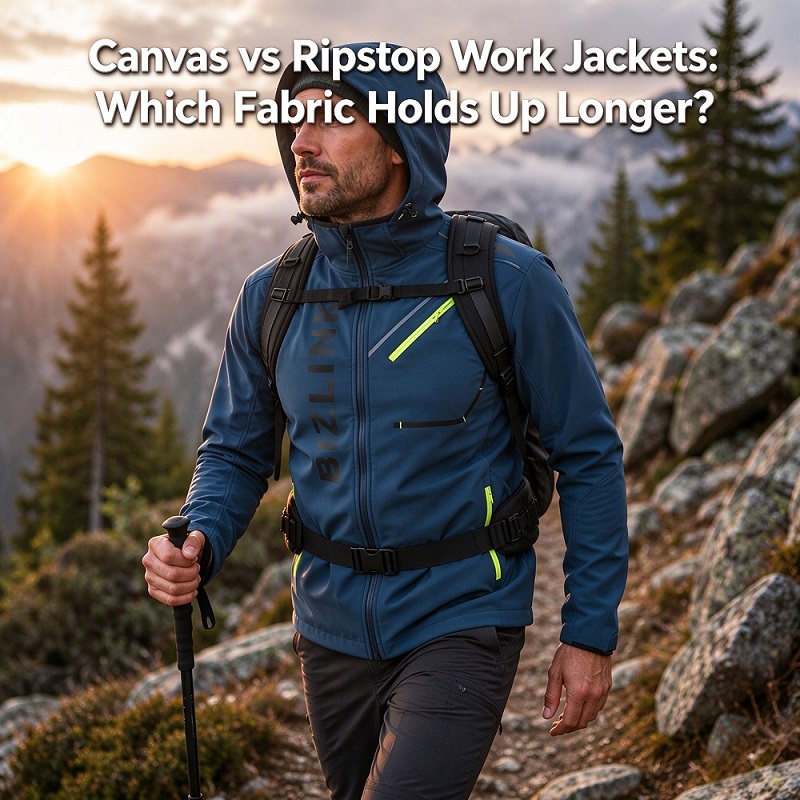
Canvas work jackets hold up better against constant abrasion and cutting, while ripstop work jackets hold up better against tearing and snagging — and that one difference decides which fabric fits your crew. If the job grinds fabric against concrete, steel or bark all day, canvas wins on wear-through. If the job snags sleeves on wire, brush or machinery, ripstop wins on tear resistance.
This guide is for distributors, safety procurement teams and brand owners sourcing canvas work jackets and ripstop work jackets for construction, welding, forestry, landscaping and industrial maintenance programs in North America and Europe. Most programs end up specifying both — a canvas work jacket for the heavy-abrasion season and a ripstop work jacket for brush and snag-heavy work — so it pays to understand each before you build the mix.
What each fabric actually does
The two fabrics are not interchangeable, and most buyers choose on weight alone. That misses the real difference, which is how each fails. When you compare a canvas work jacket against a ripstop work jacket, judge them on failure mode first:
- Canvas is a tightly woven, plain or twill fabric, usually cotton or cotton-poly. It fails by wearing thin and abrading through over time. Its strength is resistance to constant rubbing and cutting.
- Ripstop is a lightweight fabric with a reinforcing grid of stronger yarns woven at intervals, usually nylon or poly-cotton. It fails by the grid breaking down or by the coating wearing off. Its strength is stopping a small tear from running across the whole panel.
So the honest comparison is not "which is stronger." It is "which failure mode does your job hit."
Canvas vs ripstop: side by side
Factor |
Canvas |
Ripstop |
Abrasion resistance |
High — survives concrete, bark, steel |
Moderate — wears thinner with constant rubbing |
Tear resistance |
Moderate — a tear can run |
High — grid stops small tears from spreading |
Weight |
Heavy, stiff |
Light, flexible |
Breathability |
Moderate |
Better in lighter weights |
Cost |
Mid |
Lower in light weights |
Best trades |
Welding, construction, forestry, farm |
Brush, wire, utility, climbing, site cleanup |
Wash and wear |
Breaks in and softens |
Stays flexible, dries faster |
When canvas is the right work jacket fabric
Choose canvas work jackets when the damage comes from contact, not snagging. The canvas work jacket earns its place where fabric rubs against rough, unyielding surfaces all shift:
- Welding and hot work. Canvas resists sparks and contact heat better than lightweight synthetics, and heavy cotton canvas is a common outer layer in welding programs. (For FR-rated hot work, spec an FR coverall or FR jacket instead — canvas alone is not an FR claim.)
- Concrete, masonry and demolition. Grinding against rough surfaces is what canvas shrugs off. A canvas work jacket wears visibly at the elbows and cuffs but outlasts a ripstop jacket that thins in the same spots.
- Forestry and brush contact. Heavy canvas takes the scrape of bark and branches on the arms and torso.
- Farm and ranch. Canvas holds up to barbed wire contact, fence posts and equipment corners that cut lighter fabrics.
When ripstop is the right work jacket fabric
Choose ripstop work jackets when the damage comes from snagging and tearing. The ripstop work jacket earns its place where sleeves and panels catch on wire, brush or machine edges:
- Brush, wire and utility work. A snagged sleeve on a ripstop jacket stays a small hole. On canvas, the same snag can pull into a running tear.
- Climbing, scaffolding and overhead work. Ripstop is lighter and flexes with the arms, so it does not drag the worker down or bind at the shoulder.
- Site cleanup and sweeping. Lightweight ripstop is easier to move in for a full shift and dries faster after rain.
- Layering programs. Ripstop works as an outer layer over a mid layer without the bulk of canvas, which is why it pairs with softshell and fleece layers.
Construction details that matter more than the fabric
No matter which fabric you pick, the work jacket fails at the same points. Check these before you order — they matter more than the fabric label on a canvas work jacket or a ripstop work jacket:
- Elbows and forearms. These wear first on any work jacket. Double-layer or reinforced elbows extend life on both canvas and ripstop.
- Cuffs. Adjustable cuffs keep the sleeve from catching on equipment and slow wear at the opening.
- Shoulder and armhole fit. A jacket that binds at the shoulder wears out at the seam faster than the fabric. Check the size run on a real body.
- Pocket corners and stress points. Bar-tacks at pocket corners stop tears from starting at the seams.
- Zipper and closure. A heavy jacket needs a solid zip and a closure that survives the wash cycle.
Building work jackets into a wider program
Work jackets rarely stand alone in a procurement plan. The same crew usually runs a canvas work jacket for the heavy season and a softshell or fleece layer for milder days, or a ripstop shell for brush work and a heavier jacket for winter. If you already run a bibpants, trousers or hi-vis program, ask the factory to cut the work jacket from a consistent color card so the whole set matches. We covered stretch work jackets and winter layering in separate guides; the fabric logic here applies the same way when you layer a canvas work jacket under a softshell shell.
About KINGLONG (NEO SAFETY® / BIZLINK®): an SGS and ICS certified workwear manufacturer producing work jackets, bibpants, trousers, hi-vis and softshell garments for distributors and private-label brands. We support OEM/ODM with custom fabrics, colors and size-range programs. Contact our team for swatches and sample lead times.