 EN
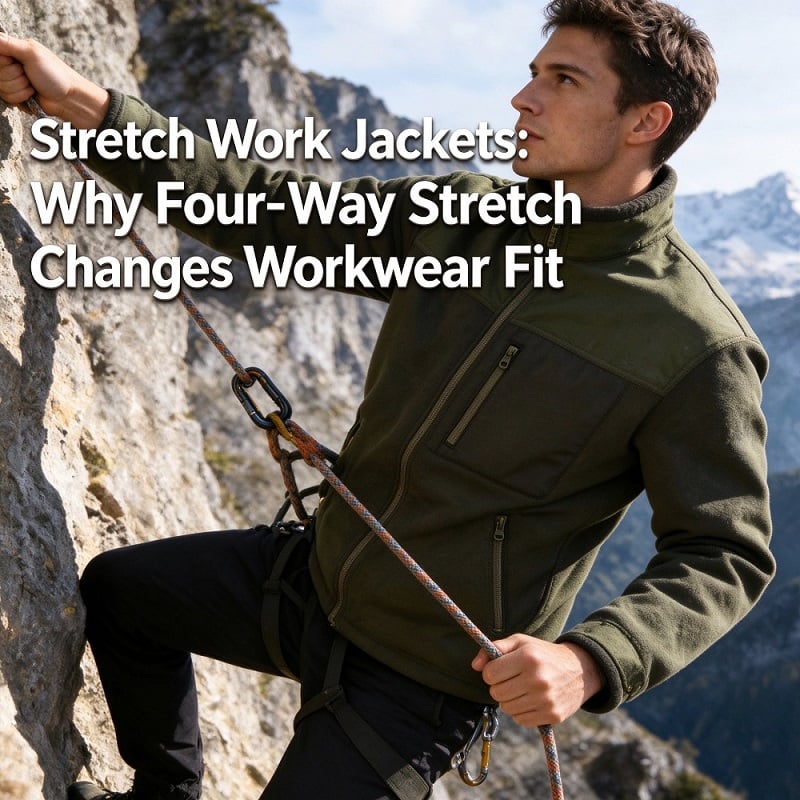
Stretch work jackets use a four-way stretch fabric (spandex or elastane blended into polyester or cotton) so the garment moves with the wearer when they reach, bend or climb a ladder. The main tradeoff buyers need to manage is stretch versus abrasion resistance — more spandex usually means a more comfortable jacket, but a faster-wearing outer face in rough trades.
This guide is for distributors, brand owners and safety procurement teams sourcing stretch work jackets for North American and European workwear programs. We have cut and sewn these garments for OEM programs, and the questions below are the ones our sales engineers hear most often before a sample order goes out. If you are comparing stretch work jackets against softshells or rigid canvas workwear, this guide should help you narrow the choice.
What "stretch" actually means on a work jacket
Stretch in workwear comes from a small percentage of elastane (spandex) blended into the fabric. Two terms come up constantly when buyers spec stretch work jackets:
- Two-way stretch: fabric stretches across the grain only. Good for comfort, but limited when the wearer reaches overhead or twists.
- Four-way stretch: fabric stretches both across and up-down. This is what most buyers actually mean when they say "stretch work jacket" — it moves with the body in multiple directions.
The percentage of elastane is small, typically 2% to 5% by weight. The rest is polyester, cotton, or a poly-cotton blend. Do not assume "stretch" means thin or lightweight. Stretch work jackets can be built in midweight or heavyweight fabrics, and the weight you choose should match the trade and the season. When you compare stretch work jacket samples, pull the fabric in both directions and feel the recovery — a quality stretch work jacket springs back immediately, while a cheaper one stays loose after a few pulls.
Factor |
Standard woven work jacket |
Stretch work jacket |
Fabric structure |
Plain woven, little give |
Elastane-blend, four-way stretch |
Reach and bend |
Jacket pulls at shoulders |
Moves with the body |
Layering over base layers |
Fits close, can bind |
Easier to layer |
Abrasion resistance |
High (dense plain weave) |
Slightly lower — outer face wears faster |
Restrictive feel |
Common in cheaper cuts |
Reduced |
Best trades |
Static bench, warehouse, slow walk |
Electrical, HVAC, roofing, installation |
The point is not that stretch replaces every work jacket. It is that for trades where the crew reaches overhead, kneels, or works on ladders, a stretch jacket reduces the constant pull that wears out both the garment and the worker. A standard rigid jacket works fine on a bench; the moment the wearer is on a ladder or under a sink, the difference in comfort becomes obvious. Buyers who have run both programs often tell us that once crews try a stretch work jacket, they ask for it on every reorder.
Fabric choices buyers usually compare
When you source stretch work jackets, the fabric face drives most of the performance:
- Polyester-spandex stretch twill. Durable, wrinkle-resistant, good for outdoor and trade work. The default for most stretch work jackets.
- Cotton-poly-spandex (chino or canvas stretch). Softer hand, more casual look, better for uniform programs where a rugged workwear look is not required.
- Stretch softshell (bonded). Combines a four-way stretch face with a windproof membrane and a brushed back. Packs wind resistance into the stretch category.
- Ripstop stretch. A ripstop grid woven into the stretch face for better tear resistance in abrasive trades.
Ask the supplier for the actual fabric composition and weight, not just the word "stretch." A lightweight stretch shirting is not the same garment as a heavyweight stretch canvas. If you are building a winter program, pair a heavier stretch face with a bonded fleece or microfleece back; if you are building a three-season jacket, a lighter stretch twill with a simple mesh or taffeta lining breathes better. Most stretch work jackets in the North American market land in the midweight range, but the exact weight should come from the supplier's spec sheet, not from this guide.
Construction details that matter
Stretch fabric only performs well when the cut and seams are built for it. A cheap stretch work jacket uses a regular rigid pattern with a stretch fabric, and you lose most of the benefit. When you evaluate stretch work jacket samples, lay them flat and look at the shoulder seam and elbow shape:
- Articulated elbows and shoulders. Flat or set-in sleeves waste the stretch. Look for pre-shaped elbows and gusseted shoulders.
- Pocket placement. Pockets on stretch fabric sag over time. Reinforced pocket bags and bar-tacks at stress points matter more on a stretch work jacket than on a rigid one.
- Cuffs and hem. Adjustable cuffs and a drawcord hem keep the jacket in place when the wearer reaches up.
- Zippers and vents. YKK-style zippers last; underarm or back vents release heat on high-output jobs.
- Reinforcement at high-wear zones. Shoulders, elbows, crotch of matching stretch pants — double-needle or bartack where the fabric flexes most.
How a stretch work jacket should fit
A good fit test on a stretch work jacket is not standing up straight in front of a mirror. Put the sample on a real worker and have them do three movements: reach overhead as if changing a wall fixture, bend at the waist as if picking up a tool, and sit on a low stool. The jacket should stay in place, ride up no more than an inch, and not pull across the shoulders. If the fabric stretches but the armhole is too small, the jacket still feels tight.
Laundering and durability
Stretch work jackets take standard industrial laundering, but the elastane does degrade over very high heat. Ask the supplier for the recommended wash temperature and tumble setting. Repeated very hot washes break the spandex down faster, and the jacket loses its recovery. For rental programs that run hot washes, confirm with the factory whether the chosen stretch fabric holds up across the expected number of cycles.
When to skip stretch?
Stretch is not always the right answer. In heavy abrasion trades — concrete work, demolition, steel — a rigid heavyweight canvas or FR-rated jacket will outlast a stretch work jacket on the jobsite. In those programs, use a stretch work jacket for the crew's everyday or cooler-weather layering piece, and reserve the rigid heavyweight for the abusive tasks. For electrical, HVAC, facility maintenance and installation crews, however, a well-built stretch work jacket usually becomes the default jacket on every reorder.
About KINGLONG (NEO SAFETY® / BIZLINK®): an SGS and ICS certified workwear manufacturer producing stretch work jackets, softshells, fleece, trousers and vests for distributors and private-label brands. We support OEM/ODM with custom fabric weights, colors, embroidery and size-range programs. Contact our team for swatches and bulk pricing.